Feng Shui FAQ Part 1
Common Questions, Answered by Lois Kramer-Perez
Have a Feng Shui question you’ve always wondered about? You’re not alone. Here are answers to some of the questions I hear most often, separating fact from fantasy.
What does “Feng Shui” actually mean?
“Feng Shui” translates to “Wind Water.” Wind is the energy you feel, Water is the energy you see. The principles of Feng Shui create a harmonious relationship between the energy you see and the energy you feel. It began in China thousands of years ago, starting with “form” siting homes and graves. That foundation is still used today, alongside directions, colors, shapes, elements, objects, and timing.
Is it true you should never use the number 4 in Feng Shui?
Not exactly. The number 4 has a “bad luck” reputation because the Chinese word for “four” sounds like death, a meaningful connection for anyone of Chinese culture. But in Feng Shui, the actual significance of the number 4 is southeast, the “tree element,” which relates to Fortunate Blessings and Prosperity. Four bamboo stalks placed in the southeast, for example, nourish fortunate blessings, which in turn nourishes reputation, recognition, and passion.
Does keeping the toilet lid closed really protect your money?
Feng Shui always promotes safe and healthy living, so closing the lid when you flush is a good habit regardless. But the deeper truth is about the water itself: bathrooms hold a lot of water, and water relates to wealth. A clogged drain can be a metaphor for money not coming: what are you neglecting or stuck on. A dripping faucet can mean money is slowly leaking away, maybe from an old subscription still on autopay. The real fix is simple: keep bathrooms clean, keep pipes maintained, and yes, close the lid.
Is it bad Feng Shui to have a mirror facing your front door?
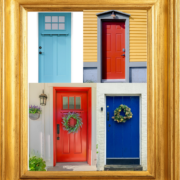
Generally, yes. A mirror placed directly opposite the front door isn’t recommended, because when you open the door, the mirror reflects the incoming energy right back out. The front door is known as the “Mouth of Chi” (Chi meaning energy), and it’s meant to welcome in health, wealth, and opportunity, not send it back out before it arrives. That said, mirrors aren’t bad on their own. Placed on a side wall in an open foyer, a mirror can beautifully balance and expand the space.
Why shouldn’t you sit with your back to the door?
Feng Shui recommends the “Command Position”: sitting with your back to a solid wall, with a clear view of the door. When your back is to a door or opening, your central nervous system can go on subtle alert, sensing you’re unprotected, even if you’re not consciously aware of it. Most people find they feel more comfortable and productive once they switch to the Command Position. Ever notice where you sit at a restaurant or where you can choose your seat in a public space or around a table? Is your back to the door?
I think not!
Is Feng Shui a religion?
No, Feng Shui is not a religion, though it has roots in Taoism and the belief that everything carries energy. “Form Feng Shui” began thousands of years ago in China as a practical system for siting gravesites and homes safely. There’s a reason behind every Feng Shui principle, and it’s practiced in many different ways, some more spiritual, some purely practical. A certified practitioner can help you find the approach that’s right for you. So, Feng Shui is not a religion yet it can help you deepen your personal spirituality.
Does placing a 3-legged frog by the front door really bring money?
Icons and objects in Feng Shui work by connecting to your subconscious. My favorite traditional story behind the 3-legged frog: a farmer walking along his way, pauses to rescue a 3-legged frog from a well, and then continues on his merry way. From that day on, the farmer wakes up each morning to find gold coins under his pillow, a reminder that giving without expectation is rewarded beyond measure. If seeing your frog reminds you to be generous and live in gratitude, it can absolutely be meaningful. The truth is this: objects are only as powerful as the actions and behaviors they inspire in you. It’s not about the object, it’s about what the object moves you to do.
Which direction should my bed face?
This is the question I get asked more than almost any other! The truth is, there’s no single “right” direction that works for everyone, it depends on you, your birth information, and what’s happening in your life right now. What I can tell you universally is this: your bed should be in the Command Position. That means a solid wall behind you, a clear view of the door, and NOT lined up directly with the door or tucked under a window. Beyond that? Let’s talk about your specific direction on a consultation, because this is exactly where “one size fits all” Feng Shui falls apart.
Is clutter really that big a deal in Feng Shui, or is that just a design trend?
Oh, it’s a big deal, and I prefer not to “name” stuff “clutter”. The items in your space are relative to you and where you are in your life. In Feng Shui, when there is too much stuff in your space which challenges the ability to walk easily without twisting & turning & bumping, is stuck energy. This goes for the drawers or closets or rooms that are avoided too! Every “I’ll deal with it later” is chi that can’t move, and chi that can’t move can’t bring you anything new. I always tell clients: you can’t invite in what you want more of if there’s no room for it to land. Clearing space isn’t just about a tidy home for the sake of tidy, it’s about making space, literally and energetically, for the next chapter.
Still have a Feng Shui question? Schedule your free Discover Your Shui call or grab my free e-book for more.
Sharin’ the shui,
Lois